
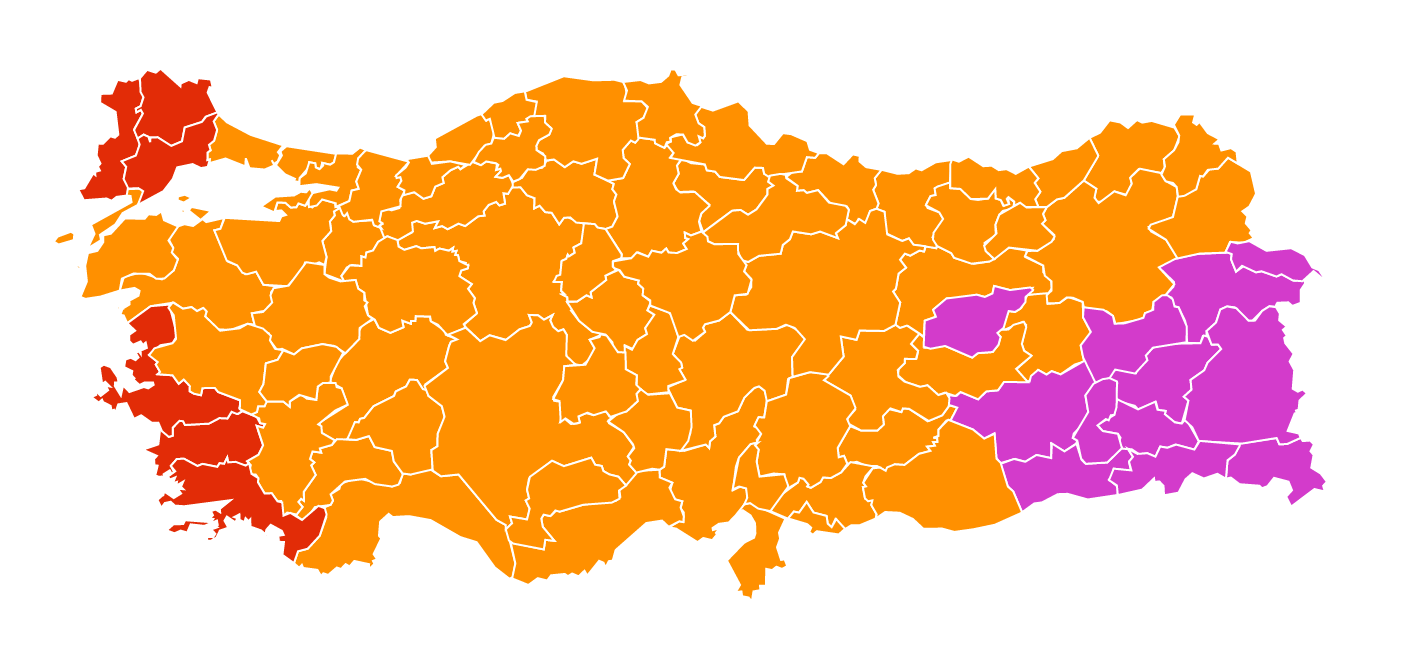
Turkey held a snap election on Sunday and the unofficial results surprised not only the pollsters and the opposition, but even the high ranking leaders of Justice and Development Party (AKP). After the 41% vote share and 258 parliamentary seats in June, this is a remarkable comeback for the party. In 4.5 months, AKP increased its vote share to 49% and its number of seats to 315, which guarantees a vote of confidence. AKP and its supporters are overjoyed as expected. The other half of the country, however, is another story.
For those who oppose the AKP, the election night was a nightmare they could not wake up from. They are not a homogenous group, of course. Some are secular Turks, some are Kurds, some are leftists, some are Turkish nationalists and some are conservatives who fell out of AKPs favor. For the most part, their only common ground is their desire to see the end of AKP’s decade long uncompromising, self-serving, polarizing, allegedly corrupt and increasingly authoritarian hold on government. Since the results started getting reported last night, they have been going through a range of emotions very much like the five stages of grief.
Step 1- Denial: The first reported AKP vote shares were around 55% on Sunday night. “But the polls predicted AKP vote share to increase only slightly,” many said in disbelief, “The state news agency must be reporting AKP districts first. Surely, this rate will come down as the night progresses.” The rate did come down, but not lower than 49%. Disbelief was further fed by strong suspicions about irregularities in the the voting process. How come the media can report 100% of the votes in two hours? Why is the Higher Election Council website down, not making us follow the official vote count? What is the source of the sizable increase in new Istanbul voters? They turned to Oy ve Ötesi (Vote and Beyond) and started entering data in this grassroots monitoring organization’s online system to verify the results ballot box by ballot box. Most of them will not get over the denial stage until Oy ve Ötesi releases a report that verifies the results.
Step 2- Anger: Some reached an understanding that the overall result of the election would not change even if some mistakes and irregularities are corrected for and they reacted in anger. They were angry that the hope for democracy that started fledgling with the June election results got crushed with a very heavy hand since then. They were angry that, after 13 years of AKP’s single-party rule, the possibility of finally having a say in government was snatched from their hands. They were angry at the political parties for not being able to form a coalition, which eventually forced the country into a snap election. They were angry at the AKP voters most. They succumbed into the worst possible reaction and kept revisiting what Aziz Nesin, the late humor writer, said: “Sixty percent of the people in Turkey are idiots.” They blamed AKP voters for giving in to AKP’s fear mongering, for getting manipulated by the nationalist and anti-Kurdish sentiments AKP pumped since the June elections, for selling their votes even. They blamed them for preferring stability under authoritarianism to the arduous road to democracy.
Step 3- Bargaining: After victory and concession speeches by the party leaders, some disappointed opposition voters hoped that AKP would act differently with the renewed confidence. AKP got what they wanted, maybe they would stop demonizing the Kurds and branding the pro-Kurdish Peoples’ Democracy Party (HDP) as terrorists. They will be back in government with a majority, maybe they would feel less threatened by critics and stop harassing what’s left of the opposition media. This will be a single-party government free from coalition dynamics, maybe Turkey could finally address the security threat from ISIS and the humanitarian disaster regarding the Syrian refugees more effectively. After all, AKP leader Davutoğlu said in his victory speech that they would take Turkey out of any kind of polarization and tension. Now that the whole election turmoil is over, maybe there could finally be some peace.
Step 4- Depression: Then, the day after the election, police raided the political magazine Nokta to stop the distribution of its critical and provocative cover. Any hope for reconciliation disappeared and the realization that the AKP has not and will not change sunk in. In the past, AKP passed many controversial laws and regulations without any regard to the opposition or any attempts at negotiation or compromise. The constitutional reforms the party passed in the past only led the country towards more authoritarianism. The AKP majorities have prevented any parliamentary inquiries into the alleged corruption cases involving Erdoğan and his close circle. Now, AKP is expected to push for the constitutional change for a presidential system and if that is the case, Turkey will likely end up with Sultanism. AKP opponents have nostalgia for the spirit of Gezi and its promise. Some resent that AKP supporters name them “white Turks” or elites, although they have had suppressed voice and very limited access to political power or patronage under AKP rule. Kurds resent that their grievance and suffering at the hands of the state never handed them a high horse such as the Islamists have been riding even though they are the state and have been for more than a decade. Half rebellious, half joking, and very much exasperated, they talk about emigration. Uruguay is mentioned as an utopian dream destination, the reality for some will be Europe or the United States eventually.
Step 5- Acceptance: Especially after Oy ve Ötesi releases its report, the discontents of AKP will start to accept that their fellow citizens have voted for the AKP and they had their valid reasons to do so. As expected, the opposition leaders have already reached this acceptance. They said they would try to make the best of the results and perform the duties of being the opposition in the parliament. Being in the opposition where a single party dominates the state is difficult, the campaign for this election made it evident. A simple comparison of leaders’ screen times during the campaigns show that the opposition has serious problems getting their voice heard, the press is not free, and the playing field is far from even. Despite all obstacles, at least, HDP passed the 10% electoral threshold, allowing a more representative parliament and preventing an AKP supermajority. At least, CHP increased its vote share, possibly gaining more ground in the center of the political spectrum. AKP is transforming and reinventing itself where necessary, so should the opposition. The opposition has to be better: Better connections with the grassroots, better connections with the minorities, better gender equality, better transparency, and putting up a good fight in defense of the remaining democratic institutions. We are, after all, the other half of the country. Our votes count, so do our freedoms, our choices, our words, and our lives.
 Ebru Erdem Akcay