
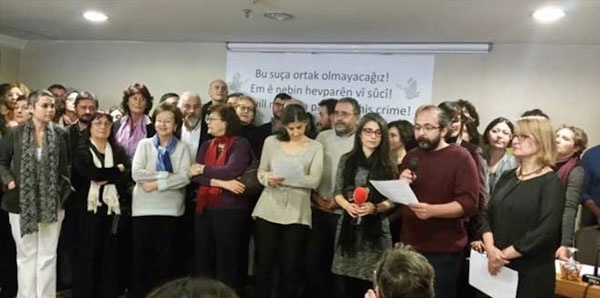
Freedom of expression and academic freedoms are under attack in Turkey. A group of scholars who signed the “Petition for Peace” are experiencing a witch hunt that puts the McCarthy period to shame. In the six days since the petition was announced on January 10, 2016, Higher Education Council (YÖK) held an emergency meeting to discuss investigations against the signatories, 38 universities started disciplinary investigations into faculty members who signed the petition, and 27 scholars were detained and released after giving statements to the police. Some scholars were removed from their positions or their administrative roles for the duration of investigations. In addition to many local prosecutor’s offices that took action against scholars in their jurisdiction, Istanbul Public Prosecutor’s Office started a criminal investigation encompassing all 1128 original signatories. Scholars who called for peace are facing serious official intimidation and retaliation for expressing their thoughts.
The “Petition for Peace (alt. link)” was written in response to the indiscriminate violence in the conflict between state security forces and Kurdistan Workers’ Party (PKK) in the Kurdish populated Southeast. The petition, headlined “We Will Not Be A Party to This Crime,” demands an end to curfews, deportations, and violence and calls for a resumption of peace talks. The text is allegedly criminal under Article 301 of the constitution, which prohibits “insulting the State of the Republic of Turkey” and Article 7 of the Law to Combat Terrorism which prohibits terrorist propaganda aimed at inciting hatred and enmity among the public. These articles transcend academic speech and make legal prosecutions possible. If the courts agree, signatories could get one to five year prison sentences.
Perhaps more disconcerting than the legal and administrative measures against the scholars is the conscious efforts by the government to shape the public opinion against the petition and its signatories. In multiple statements since January 12, 2016, President Erdoğan referred to the signatories as “so-called intellectuals,” “the fifth column,” “traitors,” and “dark.” He claimed they were ignorant about the Southeast and they did not understand the state’s efforts to combat terrorism. Erdoğan and pro-government media have taken scholars’ criticisms as treason, continuously blaming the scholars and making them the main news even when acts of terror took lives at the heart of Istanbul and in the Southeast.
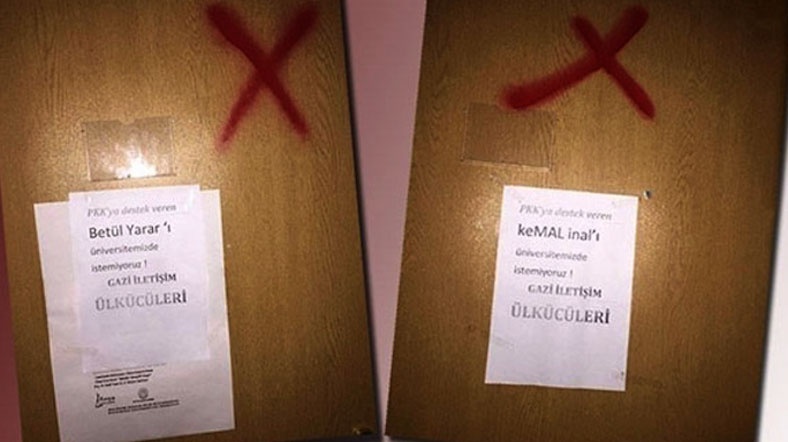
Erdoğan’s discourse on the academics was echoed by Prime Minister Ahmet Davutoğlu and other Justice and Development Party (AKP) leaders. The Justice Minister claimed that the petition was written and organized by the PKK, effectively accusing the 1128 scholars of being members of a terrorist organization. YÖK and some university administrations released statements repeating Erdoğan’s arguments. Erdoğan’s discourse had the impact of branding the academics as enemies of the state in public opinion. The public vilified the signatories as agents of the PKK or terrorists, insults and threats were directed at them on various social media outlets. One pro-government nationalist mafia leader, Sedat Peker, declared on his website: “We will spill the traitors’ blood and shower in it.” Other local nationalist groups either gave threatening statements or protested on campuses. Office doors of some scholars were marked and vandalized with threats. After police officers and civilians were murdered in PKK bombings on January 14th, 2016, people held these academics responsible, naming them “the 1128 murderers.” President Erdoğan said in the funeral next day that the scholars are “guilty of the massacre carried out by those who they stand by [PKK].” The government-led targeting and demonization of the scholars is a matter of grave concern because it puts lives of scholars, especially those at provincial universities, under threat.
Despite intimidation, retaliation, and threats, many professional groups, students, and international organizations have expressed their support for the Academics for Peace and the number of academic signatories has almost doubled since the initial list. Freedom of expression is one of the basic democratic rights and academic freedoms ensure independent and impartial scholarship. The Petition for Peace criticizes the government for its actions in the Southeast, but it does not support any kind of violent action or any terrorist organization. The reactions of the government and university administrations are unfounded and absolutely excessive. Any threat to the academics’ lives and well-being are unacceptable.
Attempts to suppress the scholars’ voice is the latest manifestation of intolerant and increasingly authoritarian government that has curbed the freedom of the press and independence of the judiciary in recent years. In the future, these scholars will be remembered as the few who held on to their reason and conscious while the government carried out indiscriminate violence and a majority of the people remained silent. I stand with the Academics for Peace and I wish them strength as they weather this storm. I will end with Martin Luther King: “The ultimate measure of a man is not where he stands in moments of comfort and convenience, but where he stands at times of challenge and controversy.” These scholars stood up for peace by taking huge risks and we all need to stand in solidarity with them.
American scholars have also written a statement to show their support with Turkish colleagues. You can join them by emailing “academicsUS@gmail.com“.
A similar initiative exists for Canadian scholars: Statement, email: canadaacademicsforpeace@gmail.com
Access to the Academics for Peace website is not reliable (possibly due to hacks and attacks); they can be followed on their Facebook page.
 Ebru Erdem Akcay